A machined saddle, not a bolt-on accessory.
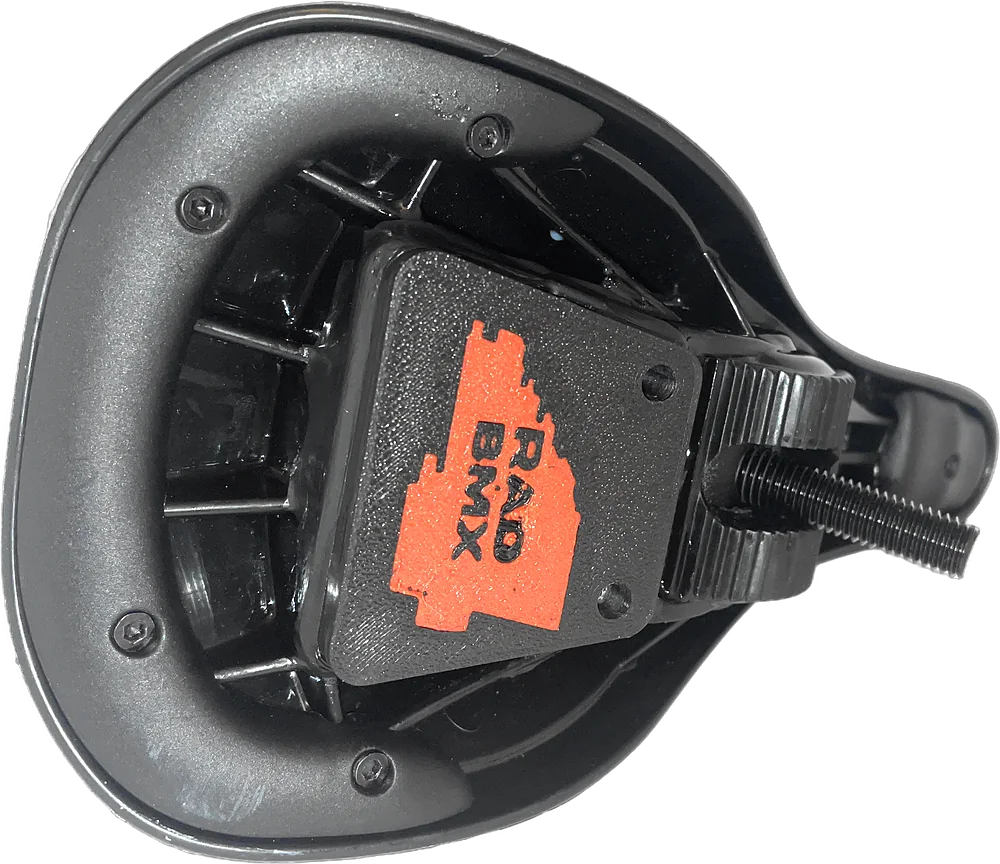
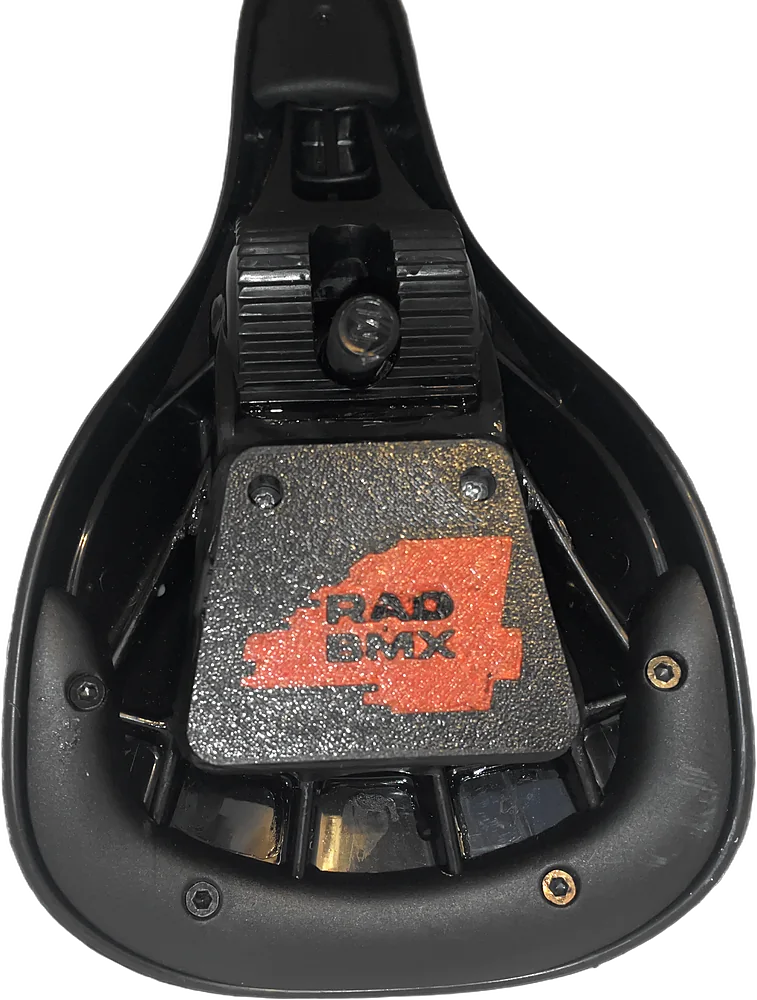
Every RAD 4 BMX starts from a polycarbonate pivotal saddle, machined under the seat to house the electronics and battery in a permanently fixed housing. The sensor doesn't come off, doesn't run flat without you knowing, and doesn't get lost in a bag.


What's inside
| Base | Pivotal saddle, polycarbonate shell |
| Sensor | RAD Signal sensor — 25 Hz GNSS (GPS/Glonass/Galileo/Beidou), ground accuracy <10 cm |
| Motion | ±8G accelerometer, ±320°/s gyroscope |
| Connectivity | Bluetooth 5.2, pairing with the RAD 4 BMX app, available on the App Store and Google Play |
| Power | Rechargeable battery, USB-C charging |
| Battery life | 2h+ of continuous recording at 25 Hz |
| Mounting | 100% integrated — electronics and battery in a housing permanently fixed under the seat |
What it measures
Speed & position
Full GPS trace of the moto, instantaneous speed point by point.
Acceleration
Corner exits, re-accelerations, jump landings — the real intensity of every phase.
Cornering angle
How far the bike leans in a turn, to measure the line you took rather than guess it.
Your moto, exactly as you'll see it — not a mock-up.
A real screenshot of the RAD 4 BMX app, on the PH Sauze track of BMX Pernois in Pernes-les-Fontaines (Vaucluse, France): session summary, lap times and times at each point of the track, GPS trace — all compared automatically.

 Bluetooth pairing, live telemetry and statistics, on iPhone and Android.

Best time, consistency and lap-by-lap comparison, calculated automatically over the session.
- 📍 Full GPS trace of the track, corner by corner
- ⏱️ Laps detected and compared automatically (Δ against the best time)
- 📈 Speed and bike angle overlaid on the same chart
- 📱 The same view on your phone, while you're still at the track

Preparation tools, not just numbers.
🗺️ My tracks
Set up your own tracks and place your virtual timing gates wherever you like — to target exactly the corner or section you want to work on, session after session, rather than putting up with an automatic split that doesn't match today's goal.
🔧 Toolbox
Gear ratio calculator and start-hill simulation to find the optimal gearing for your height, weight and level — the calculations a rider usually does in their head or on the back of an envelope, with real numbers behind them.
🚀 Start simulation
The official BMX gate cadence — lights and beeps, random delay before green — to practise gate starts in the same conditions as in a race.
Timed sprints, without timing cells or a stopwatch.
You choose the number of sprints, the distance and the type of start — standing, like an official BMX gate (light and sound sequence, random delay before green), or rolling (the app arms the timer as soon as you reach the entry speed you've set). No more physical timing cells or counting out loud: the app places virtual timing gates along the whole sprint, so you can see your progress point by point — not just a total time at the finish.
- 📍 Virtual timing gates placed automatically along the sprint, nothing to set up
- 🚦 Standing start (BMX gate) or rolling start, your choice
- 📏 Adjustable distance and number of sprints
- ⭐ Every sprint automatically compared to the best of the session, gate by gate
- 👀 Visible to your coach, like any track session

Virtual timing gates placed automatically along the sprint — the time between two of them, compared to the best run.
For the coach, the same data changes scale.
The speed, acceleration and cornering angle measured by each saddle aren't only useful to the rider using it. A coach linked to several riders gets the same data compared moto after moto, session after session — enough to measure a difference in line or re-acceleration rather than guess it from the side of the track.
See coach pricingWhat the coach does with it
- Live tracking of riders on race day
- Race results tracking
- Fitness tracking, session after session
- Progress tracking over time
- Interactive creation of training programmes
Custom machining, not a modification.
Machining the cavity
The underside of the pivotal saddle is machined to create a cavity sized exactly for the sensor and the battery.
Electronics integration
The RAD Signal sensor and its USB-C rechargeable battery are positioned in the cavity.
Fixing the housing
The housing is permanently fixed under the seat — the electronics become part of the saddle, protected from impacts.
The USB-C charging port remains accessible from the outside to charge the battery without taking anything apart.
€99 + €29 + delivery
Saddle, sensor and battery — paid once. The Rider subscription then starts as soon as you pair your saddle.
Order my saddle